
China’s physiotherapy equipment sector serves clinics, hospitals, rehabilitation centers, and home-care providers. This guide to China’s top 10 physiotherapy equipment manufacturers offers buyers a practical starting point, not a universal ranking. Company strengths vary. Some focus on treatment tables and mobility aids; others offer electrotherapy, ultrasound, or rehabilitation training systems.
Choosing Physiotherapy Tools Equipment takes more than comparing catalog photos or headline prices. Buyers should examine product specifications, intended clinical use, quality controls, warranty terms, spare-part access, and staff training. Ask how a device is tested and serviced, and request clear documentation before making a purchase. These details matter when a machine must fit a busy treatment room, pass through a narrow doorway, or remain usable after years of daily sessions. A polished brochure is not proof of dependable support. That matters.
Physical therapist and educator Shirley Sahrmann’s movement-system framework describes it as “the primary system of the body.” The idea is a useful reminder: equipment supports assessment and treatment, but it does not replace clinical reasoning or a tailored care plan. Not always. This overview considers manufacturers through practical buyer questions, including product range, customization, export experience, and after-sales service. Evidence can be uneven, and company claims deserve checking. A shortlist is a beginning, not a verdict. For procurement teams, that small distinction can prevent an expensive mismatch between a device’s advertised features and the needs of real patients.
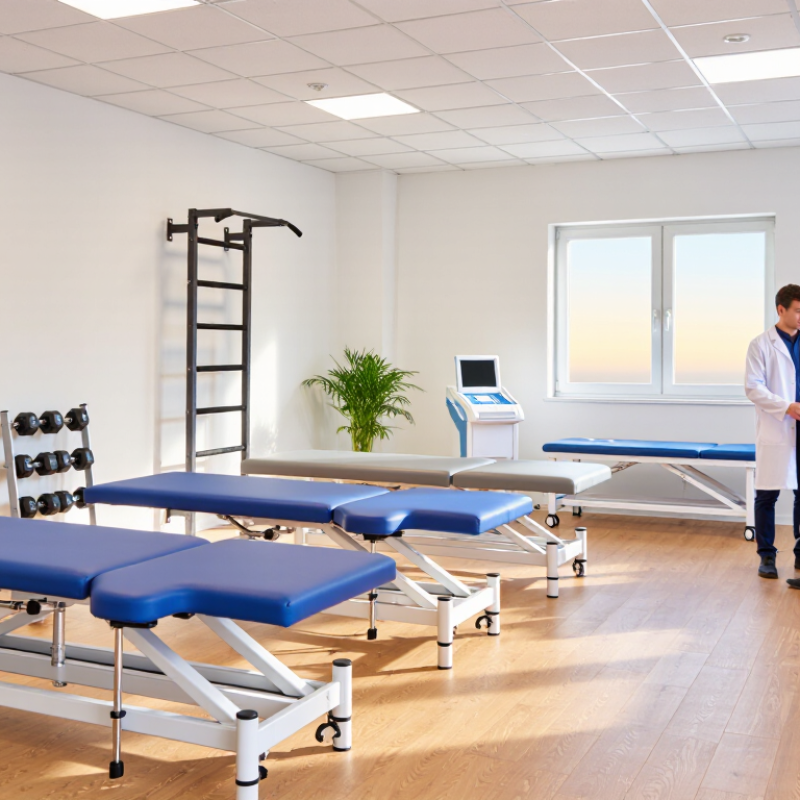
China’s physiotherapy equipment industry combines medical-device engineering with a broad manufacturing supply chain. Producers make treatment tables, exercise systems, electrotherapy units, ultrasound devices, and mobility-training equipment. Metal frames, molded plastics, motors, sensors, and control panels may come from different specialist suppliers, then meet during assembly and testing.
For buyers, the product category matters less than how consistently a factory controls its process. A clinic may need a table that adjusts smoothly, locks securely, and is easy to clean between patients. A rehabilitation center using resistance equipment may care more about stable movement, clear load settings, and replaceable parts. These details are practical, not glamorous. They also reveal where a specification sheet can leave questions unanswered.
Manufacturers vary in their strengths. Some focus on high-volume production, while others handle smaller customized orders. Inspection records, component traceability, electrical safety checks, and documented performance tests offer useful evidence of quality. Ask how faults are handled after shipment, too. Support can be uneven. A careful evaluation should include sample testing, production capacity, and service arrangements, rather than relying on price or appearance alone. One limitation remains: polished samples do not always reflect routine factory output, so ongoing quality checks matter.
Selecting China’s top ten physiotherapy equipment manufacturers requires more than comparing catalogues or factory size. A transparent scorecard should assess clinical relevance, safety documentation, manufacturing consistency, after-sales support, and product evidence. The World Health Organization’s 2023 rehabilitation fact sheet estimates that 2.4 billion people live with conditions that may benefit from rehabilitation. This measures health need, not equipment sales, but it explains why dependable devices matter. Reviewers should check intended users, adjustment ranges, maintenance schedules, and clear operating instructions.
Technical checks can include quality records, calibration procedures where relevant, sample testing, and realistic spare-parts timelines. ISO 13485:2016 outlines quality-management requirements for medical-device organizations, but certification alone cannot prove every model performs well in a clinic. The WHO and UNICEF Global Report on Assistive Technology (2022) estimates that more than 2.5 billion people need one or more assistive products. That category is broader than physiotherapy equipment, so it should not be treated as a market-size estimate. Evaluators can score each criterion and disclose missing evidence. No score is perfect. A factory visit may reveal a stiff adjustment knob, frayed cable, or awkward cleaning step that a brochure never shows. Weighting choices still deserve scrutiny.
Profiles of China’s Top 10 Physiotherapy Equipment Manufacturers should compare capabilities, not just catalog size. A useful profile notes product focus, clinical application, quality documentation, and after-sales support. Some manufacturers specialize in electrotherapy or traction; others build balance trainers, treatment tables, or robotic rehabilitation systems. WHO’s 2023 rehabilitation fact sheet estimates that 2.4 billion people worldwide could benefit from rehabilitation. That demand makes reliable equipment and clear user training important.
For each manufacturer, examine whether product specifications match the intended setting, from a small outpatient room to a hospital gym. Ask about testing records, maintenance intervals, spare-part availability, and operator training. A polished catalog is not proof of clinical performance. The “top 10” label is not a perfect science, either: rankings can shift with product scope, export reach, and evaluation criteria. Readers should verify current certifications and trial equipment where possible.
Tips: Compare warranty terms and service response times, not only purchase prices. Check that adjustment knobs, cables, and contact surfaces are easy to clean and inspect. Small details matter. WHO’s estimate describes rehabilitation need, not equipment sales, so it should not be treated as a market-size figure.
China’s population aged 60 and above grew from 264.02 million in 2020 to 296.97 million in 2023. This demographic trend provides context for demand across healthcare and rehabilitation services; the chart does not rank or compare manufacturers. Source: China National Bureau of Statistics.
Physiotherapy equipment spans simple treatment-room tools and sensor-based rehabilitation systems. Common products include therapy tables, resistance bands, balance platforms, electrotherapy units, and therapeutic ultrasound devices. Each serves a different clinical task. A height-adjustable table, for example, can make transfers easier, while a force sensor can show how evenly a patient loads each leg.
Technology is becoming more connected, but practical design still matters. Motion-capture cameras and wearable sensors can record joint movement during walking exercises. Software may turn those measurements into progress charts for clinicians to review. Treadmills with body-weight support provide another option for supervised gait training. Small details matter. Clear controls, stable handrails, and easy-to-clean surfaces affect daily use more than a crowded feature list.
Product specifications need careful reading. Measurement accuracy, adjustment range, maintenance needs, and staff training all influence whether a device fits a clinic. A digital display may look precise, yet data can be difficult to interpret without consistent setup. That is easy to overlook. Buyers should also check how equipment handles different body sizes and mobility levels. Some product descriptions leave these practical questions unanswered, so demonstrations and technical documentation deserve close attention.
Industry overview: the entries below are anonymized product-specialty profiles, not a ranked list or claims about specific manufacturers.
| Profile | Product Specialization | Representative Equipment | Key Technologies | Typical Applications | Evaluation Considerations |
|---|---|---|---|---|---|
| 01 | Electrotherapy | TENS, NMES/EMS, and interferential-current units | Controlled pulse frequency, pulse width, intensity, and channel output | Pain-management programs and muscle stimulation in rehabilitation settings | Check waveform specifications, channel configuration, electrode compatibility, and safety controls. |
| 02 | Therapeutic ultrasound | Portable and clinic-based ultrasound therapy units | Acoustic energy delivery, adjustable output, and continuous or pulsed operation | Therapeutic treatment of selected soft-tissue and musculoskeletal conditions | Review operating frequency, effective radiating area, intensity range, calibration, and applicator design. |
| 03 | Shockwave therapy | Radial pressure-wave therapy systems and applicators | Pneumatic generation of pressure waves with adjustable treatment parameters | Selected musculoskeletal rehabilitation protocols, as determined by a qualified clinician | Distinguish radial pressure-wave devices from focused shockwave systems; verify energy data and consumables. |
| 04 | Photobiomodulation | Low-level laser and LED therapy devices | Red or near-infrared light delivery with specified wavelength and output settings | Adjunctive treatment in selected pain and rehabilitation protocols | Compare wavelength, irradiance, treatment area, dose controls, and eye-safety provisions. |
| 05 | Traction therapy | Cervical and lumbar traction tables or systems | Programmable force, treatment duration, and intermittent or sustained traction modes | Clinician-supervised spinal traction as part of selected care plans | Assess force range, positioning, emergency release, patient restraints, and table capacity. |
| 06 | Continuous passive motion | Knee or other joint CPM devices | Motorized, adjustable joint range of motion, speed, and cycle settings | Assisted passive joint movement during clinician-directed rehabilitation | Check fitting range, movement limits, controls, cleaning requirements, and patient setup instructions. |
| 07 | Rehabilitation exercise equipment | Upper- and lower-limb exercisers, pulleys, and resistance systems | Adjustable resistance, mechanical range control, and ergonomic patient positioning | Mobility, strength, and functional exercise in rehabilitation clinics | Review stability, load limits, adjustability, accessibility, and maintenance needs. |
| 08 | Thermal therapy | Hot-pack units, heating pads, and cold-therapy equipment | Temperature regulation, insulated treatment packs, and timed treatment cycles | Supervised heat or cold applications used as part of rehabilitation care | Check temperature control, overheat protection, pack handling, and cleaning procedures. |
| 09 | Combination therapy systems | Units combining modalities such as ultrasound and electrotherapy | Integrated modality controls, selectable treatment programs, and shared user interface | Clinics seeking multiple treatment modalities in one platform | Verify the specifications, accessories, and safety features of each modality separately. |
| 10 | Balance and gait rehabilitation | Balance platforms, gait-training aids, and supported walking equipment | Adjustable support, stability features, and, where provided, movement or balance feedback | Supervised balance, mobility, and gait practice | Assess fall-prevention features, frame stability, user capacity, and suitability for the intended setting. |
Product features vary by model. Confirm current technical documentation, applicable regulatory status, service support, and intended use with the supplier before purchase.
For China’s physiotherapy equipment manufacturers, quality claims matter only when buyers can verify them. ISO 13485 provides a quality-management framework for medical devices, while ISO 14971 addresses risk management. Electrical equipment may also require testing against applicable IEC 60601 standards. Requirements depend on the product and destination market. A treadmill, a treatment table, and an electrotherapy unit do not face identical checks.
Certifications are only one part of market access. China’s NMPA, the EU’s Medical Device Regulation, and US FDA requirements may involve different registration, documentation, and labeling steps. Buyers should request current certificates, test reports, product-specific registrations, and traceability details. Check the model number. A certificate for one product does not automatically cover an entire catalog. Small paperwork gaps can delay shipments.
Global demand is supported by rising rehabilitation needs, but precise market-size estimates vary by report scope. The WHO and UNICEF Global Report on Assistive Technology (2022) estimates that more than 2.5 billion people need at least one assistive product; that figure is broader than physiotherapy equipment alone. It signals a substantial need for accessible rehabilitation services, not guaranteed sales. Factory audits and sample testing can reveal practical issues, such as unstable handrails or unclear calibration records. Still, paperwork cannot replace careful use testing. An uncomfortable truth: even good suppliers sometimes miss details.
